
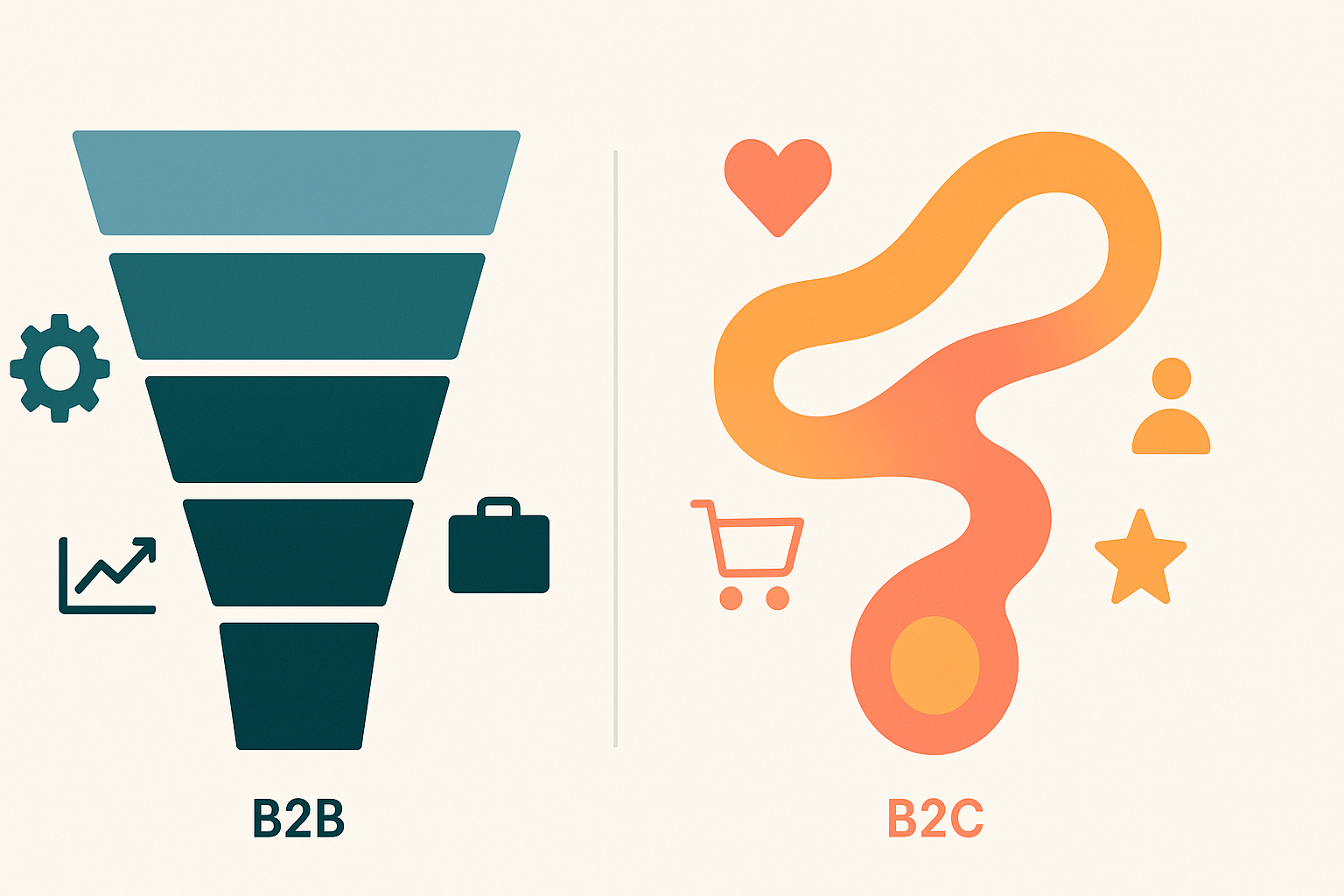
B2B vs. B2C Lead Generation
So, you’re trying to get your head around B2B versus B2C lead generation? Good call. Understanding the difference is key, and honestly, it can save you a lot of headaches (and marketing budget!).
Simply put, lead generation is just the process of finding people who might be interested in what you offer and turning them into potential customers (leads). But how you find those people changes completely depending on who you’re selling to:
- B2C (Business-to-Consumer): Selling directly to individual people.
- B2B (Business-to-Business): Selling to other companies.
Why does this tiny difference matter so much? Because mixing up your approach is like trying to use a map of London to navigate New York – you won’t get very far.
In this post, I’ll break down the core differences between B2B and B2C lead generation in simple terms. We’ll look at who buys, why they buy, how long it takes, and the best ways to reach them, using real examples and data points we’ve gathered. Ready? Let’s clear things up.
The Biggest Difference: Who You’re Talking To (And Why They Care)
Alright, let’s get straight to the heart of it. The absolute biggest difference between B2C and B2B lead generation boils down to who you’re actually talking to and what motivates them to even listen, let alone buy.
Selling to People (B2C): It’s Often Personal
When you’re in the B2C world, you’re talking directly to individual consumers. Think about yourself when you’re shopping online or walking down the street. What makes you stop and look?
Usually, B2C buying decisions are driven by:
- Personal Needs & Wants: “I need new running shoes,” or “I really want that new phone.”
- Emotions & Feelings: “This brand makes me feel good,” or “That ad was really funny/touching.”
- Lifestyle & Status: “Wearing this will look cool,” or “Having this gadget is important.”
It often comes down to solving a personal problem (like needing shoes) or fulfilling a desire. As marketing platform Logical Position notes, emotions play a big role. Remember that clothing brand using Instagram influencers? They’re tapping into desires for style and belonging. The sales cycle is often shorter because the decision rests with one person and their feelings or immediate needs.
Selling to Businesses (B2B): It’s About Logic and Value
Now, let’s flip over to B2B. Here, you’re selling to other companies. This changes everything.
You’re not usually talking to just one person making a snap decision. Instead, you might be dealing with:
- Specific Roles: A Marketing Director, an IT Manager, a Head of Operations.
- A Whole Team: Often called a Decision-Making Unit (DMU), where people from different departments (like finance, IT, and the team who’ll actually use the product) all have a say. You can see this mentioned in places like Quora discussions about B2B sales.
And their motivation? It’s rarely about personal feelings. B2B decisions are typically driven by:
- Logic & Reason: “Does this solution make sense for our workflow?”
- Return on Investment (ROI): “Will this make us more money or save us money in the long run?”
- Efficiency & Problem-Solving: “Will this fix a specific business challenge we have?” (Like the software company offering a whitepaper on efficiency gains we talked about earlier).
Think about a company buying expensive software. They need data, proof, case studies, and consensus. It’s a logical process focused on business value, which is why, as noted by Sales Force Europe and others, the B2B sales cycle is usually much longer and involves more people.
In a Nutshell:
B2C often connects through emotion and personal benefit. B2B typically connects through logic, data, and business value.
Understanding this core difference is the first huge step in choosing the right way to generate leads.
B2B vs B2B Lead Gen Key Differences: Let’s Break It Down
Knowing who you’re talking to and why they care is the foundation. But the differences between B2B and B2C lead generation ripple out into almost every part of your strategy. Let’s look at some other crucial ways they part ways:
1. How Long Does It Take? (The Sales Cycle)
- B2C: Think fast! Purchases can happen in minutes or hours. Someone sees an ad for a cool t-shirt, clicks, likes it, and buys it. It’s often quick, sometimes impulsive. Sales Force Europe highlights this shorter cycle.
- B2B: Think marathon, not sprint. Closing a deal can take weeks, months, or even years, especially for complex or expensive solutions. Why? More people are involved, there are contracts to sign, budgets to approve, and often technical checks needed. B2B Marketing resources frequently emphasize this longer, multi-step process.
2. Who Makes the Call? (The Purchase Decision)
- B2C: Usually, it’s just one person (or maybe a couple) making the decision based on their own needs and feelings. The perceived risk is often lower.
- B2B: It’s often a committee (that DMU we talked about). You need to convince multiple people – maybe IT about security, Finance about cost, and the actual users about usability. As discussed on platforms like Quora, the decision is much more rational, focused on ROI, and people are naturally more risk-averse because a bad decision impacts the company (and potentially their job!).
3. Quality vs. Quantity? (Lead Value & Volume)
- B2C: Often involves selling lots of items at a lower price point. Success might mean getting thousands of leads or sales. The value per lead is typically lower.
- B2B: Deals are often worth much more (think thousands, tens of thousands, or even millions!). So, you need fewer leads, but they need to be the right ones – highly qualified. This means B2B leads often cost more to acquire (you’ll see higher Cost Per Click discussed in places like Reddit’s r/googleads), but the potential payoff for each one is significantly higher.
4. Where Do You Find Them? (Marketing Channels)
- B2C: You’re usually casting a wider net. Think social media like Instagram, Facebook, TikTok, YouTube, search engines (SEO/PPC), and email marketing focused on promotions and engagement.
- B2B: You need to be more targeted. LinkedIn is huge here because you can target by job title and industry. Other key channels include targeted email marketing, industry events, webinars, and sometimes specialized publications. While B2B might use platforms like Instagram or Facebook, it’s often for brand building rather than direct lead generation in the same way B2C uses them (a nuance often discussed in marketing forums like r/marketing).
5. What Do You Say? (Content & Messaging)
- B2C: Grab attention quickly! Messaging is often benefit-driven, entertaining, or lifestyle-focused. Think catchy ads, customer reviews, influencer posts, promotions, and highlighting how a product makes someone feel. Logical Position points this out well.
- B2B: Build trust and prove value. Content needs to be educational, data-driven, and focused on solving business problems. Think detailed whitepapers, case studies showing ROI, webinars demonstrating expertise, and blog posts offering industry insights, as suggested by Sales Force Europe.
6. Is It a Date or a Marriage? (Relationship Focus)
- B2C: Can sometimes feel more transactional (“buy this now!”), although building brand loyalty for repeat purchases is definitely important.
- B2B: It’s all about building long-term relationships and trust. Because deals are complex and high-value, buyers need to trust the vendor. This involves ongoing communication, support, and partnership, a point often emphasized in B2B discussions on Quora and elsewhere.
Phew! That’s quite a list of differences, right? Seeing how these play out with real examples makes it even clearer, which is exactly where we’re headed next.
Seeing is Believing: Real Examples & Results
Okay, we’ve covered the main differences in theory. But what does this actually look like in practice? Sometimes seeing clear examples and real results helps everything click into place.
A Typical B2B Scenario:
Imagine a company that sells sophisticated project management software to other businesses (B2B).
- Their Approach: Instead of running flashy ads everywhere, they might create a detailed guide like “The Ultimate Guide to Boosting Your Team’s Productivity.” They’d promote this guide on LinkedIn, specifically targeting people with job titles like “Project Manager” or “Chief Operating Officer.” To download the guide, interested people provide their email address (becoming a lead).
- What Happens Next: The software company doesn’t expect an immediate sale. They follow up with a series of helpful emails, perhaps inviting the lead to a webinar showing the software in action, or sharing a case study. They focus on building trust and demonstrating value over time before trying to schedule a sales demo. It’s educational, targeted, and respects the longer decision-making process.
A Typical B2C Scenario:
Now, think about a company selling trendy workout clothes directly to customers (B2C).
- Their Approach: They might collaborate with popular fitness influencers on Instagram and TikTok to showcase their latest collection in action. They’ll likely run eye-catching video ads on these platforms, targeting users interested in fitness, fashion, and wellness.
- What Happens Next: The goal here is often immediate action. The ads and influencer posts link directly to the product page on their website. They might offer a limited-time discount code (“Get 20% Off This Weekend Only!”) to create urgency. It’s visual, taps into desire, and aims for a quick purchase.
Real Companies, Real Results:
These aren’t just made-up scenarios; successful companies tailor their strategies like this every day. Check out these quick examples based on published case studies:
- B2B Success (Axure): Axure, a software company, used highly targeted Pay-Per-Click (PPC) ads and focused Search Engine Optimization (SEO) to reach businesses looking for their specific solution. The result? They slashed their cost per lead down to just $10 and boosted conversions by an incredible 7,266%! (Source: Single Grain). That’s the power of precise B2B targeting.
- B2B Success (BMC Software): BMC Software, selling IT solutions, generated 5,000 leads and over 2,500 sales-ready leads by focusing on nurturing contacts already in their database – showing the value of relationship building over the long B2B cycle. (Source: Single Grain).
- B2C Success (Travel Agency): On the B2C side, the agency Marketing Masala helped a travel company cut their cost per lead by 50% and cost per click by 40% using paid ads and content marketing designed for broad appeal and efficiency. (Source: Marketing Masala).
- B2C Success (Home Services): Another agency, BusySeed, helped a local home services company get 321 conversions (people booking services) in just 11 months using SEO and Google Ads – perfect for capturing B2C customers searching with an immediate need. (Source: Targeted B2C Lead Generation).
As you can see, tailoring your approach based on whether your audience is businesses or individual consumers isn’t just academic – it drives real, measurable results.
Why You Can’t Just Wing It (The Cost of Getting It Wrong)
So, why have we spent all this time drilling down into the differences? Because choosing the wrong playbook – using B2C tactics when you should be using B2B, or vice versa – usually leads to a few key problems:
- Wasted Money: Pouring your budget into channels your ideal customer doesn’t use.
- Wasted Time: Chasing leads that will never convert.
- Lots of Frustration: For you, your marketing team, and your sales team.
Let’s look at how this plays out:
When B2C Tactics Meet a B2B Audience… It Usually Flops.
Imagine trying to sell that sophisticated B2B software we talked about earlier, but using purely B2C tactics:
- You run flashy, emotional ads on Facebook and Instagram showing happy people using laptops.
- Your message focuses on “feeling productive” rather than hard data like cost savings or efficiency gains.
- You push for an immediate demo signup from the first click.
What typically happens?
- You might get some clicks, but probably not from the actual decision-makers (the CTO, the Finance Manager) who need logical arguments and ROI proof.
- The leads you generate are likely unqualified because they clicked out of curiosity, not business need.
- Your sales team gets frustrated chasing dead ends.
- You’ve spent your budget talking at a broad audience instead of to the specific business roles that matter. It’s like shouting into a huge crowd hoping the one person you need hears you.
When B2B Tactics Meet a B2C Audience… It’s Often Overkill.
Now, let’s flip it. What if that trendy workout clothing brand tried using a pure B2B approach?
- They publish a 30-page whitepaper on “The Advanced Polymer Science of Modern Athleisure Fabrics.”
- They focus their outreach solely on highly detailed LinkedIn articles targeting ‘Fashion Consumers’.
- Their website requires potential buyers to fill out a long form and wait for a consultation call to discuss fabric performance metrics.
What typically happens?
- Most everyday consumers looking for cool workout gear will just scroll right past. It’s too complex and slow.
- You completely miss the impulse buyers and the emotional connection driven by visuals and trends on platforms like Instagram or TikTok.
- The lengthy process kills any desire for a quick, easy purchase. It’s like asking someone to read a technical manual before they can buy a candy bar.
The Bottom Line: Strategy MUST Match Context
The way people research, evaluate, and ultimately decide to buy something is fundamentally different when they’re shopping for themselves versus making a decision for their company. Your lead generation strategy has to respect that reality.
Understanding this difference is the crucial first step to building a plan that actually brings in the right kind of leads for your specific business.
Focusing on B2B? Here’s What Really Matters
So, if your business sells primarily to other businesses (B2B), you’ve likely been nodding along to many of the points we’ve covered. You live those realities every day!
Dealing with those longer sales cycles, navigating the various people involved in the Decision-Making Unit (DMU), crafting messages packed with logic and ROI, and the critical need to build deep trust – it’s definitely a different world compared to the faster pace of B2C.
Success in B2B lead generation rarely comes from quick wins or flashy, broad campaigns. It demands a more strategic, patient, and targeted approach. Based on everything we’ve seen, getting B2B right typically involves:
- Deep Audience Understanding: Really knowing the specific job roles you’re targeting, their biggest challenges, and what language speaks to them.
- High-Value Content: Creating genuinely useful, educational content – think insightful whitepapers, compelling case studies showing real results, practical webinars – that establishes your expertise and builds credibility over time.
- Strategic Channel Use: Mastering platforms where business professionals gather, especially LinkedIn, alongside highly targeted email campaigns and sometimes industry-specific outreach.
- Patient Nurturing: Understanding that B2B leads often need time and multiple touchpoints to become sales-ready. It’s about building relationships and providing value consistently.
Navigating B2B complexities like these is exactly where specialized expertise comes in handy. It requires a dedicated focus on the business buyer’s unique journey. For instance, driving results like Axure’s massive conversion improvements or BMC Software’s success in generating thousands of qualified leads hinges on applying these B2B-specific principles effectively.
Whether you’re building your B2B lead generation strategy in-house or considering working with a focused partner, mastering these elements – the deep understanding, valuable content, targeted outreach, and patient nurturing – is absolutely crucial for attracting high-quality leads and achieving sustainable growth in the B2B arena.
Wrapping It Up: Know Your Path
Alright, we’ve covered a lot of ground comparing B2B and B2C lead generation! If there’s one thing to take away, it’s this: they are fundamentally different, and your strategy must reflect that. Trying to use a one-size-fits-all approach just doesn’t work.
Here’s a super quick recap of the core differences:
- Who Buys: B2C targets individuals, while B2B targets businesses (often specific roles or teams/DMUs).
- Why They Buy: B2C decisions are often driven by personal need, emotion, or status, whereas B2B decisions rely heavily on logic, ROI, and solving business problems.
- How Long It Takes: B2C sales cycles are typically short and simple, while B2B cycles are much longer and more complex.
- How You Reach Them: B2C often uses broad channels like social media (Instagram, Facebook, TikTok), while B2B focuses on more targeted channels like LinkedIn and specific industry outreach.
- What You Say: B2C messaging is often benefit-driven and engaging, while B2B content needs to be educational, data-driven, and value-focused.
- The Relationship: B2C can be transactional or focus on brand loyalty, while B2B requires building long-term trust and partnerships.
Understanding these distinctions is crucial. It helps you choose the right places to find potential customers, craft messages that actually resonate, allocate your budget wisely, and set realistic goals for your marketing and sales efforts.
So, What’s Your Next Step?
- Identify Your Focus: First things first – are you primarily operating in a B2B or B2C market? Get crystal clear on this.
- Review Your Strategy: Take an honest look at your current lead generation activities. Do your channels, messaging, and tactics align with the B2B or B2C principles we’ve discussed? Where could you make adjustments?
- Dive Deeper: Use this foundational knowledge to explore more specific tactics and strategies tailored to your specific market (B2B or B2C).
Need Help with B2B?
And specifically, if you’re navigating the often-complex world of B2B lead generation – dealing with those longer sales cycles, multiple decision-makers, and the need for value-driven content – and feel you could use expert guidance, that’s exactly what we specialize in. We help B2B companies build effective strategies to attract and nurture high-quality leads. Feel free to reach out if you’d like to chat about how we could help your business grow.
Thanks for reading! Getting clear on B2B vs. B2C is a huge step towards smarter, more effective lead generation. Good luck!